There are many ancient cities around Antalya. Some stand in the mountains and must be reached on foot, while others lie on the plain beside a road. This article brings together cities crossed by our routes and large complexes worth visiting separately.
Cities on Our Routes
Termessos
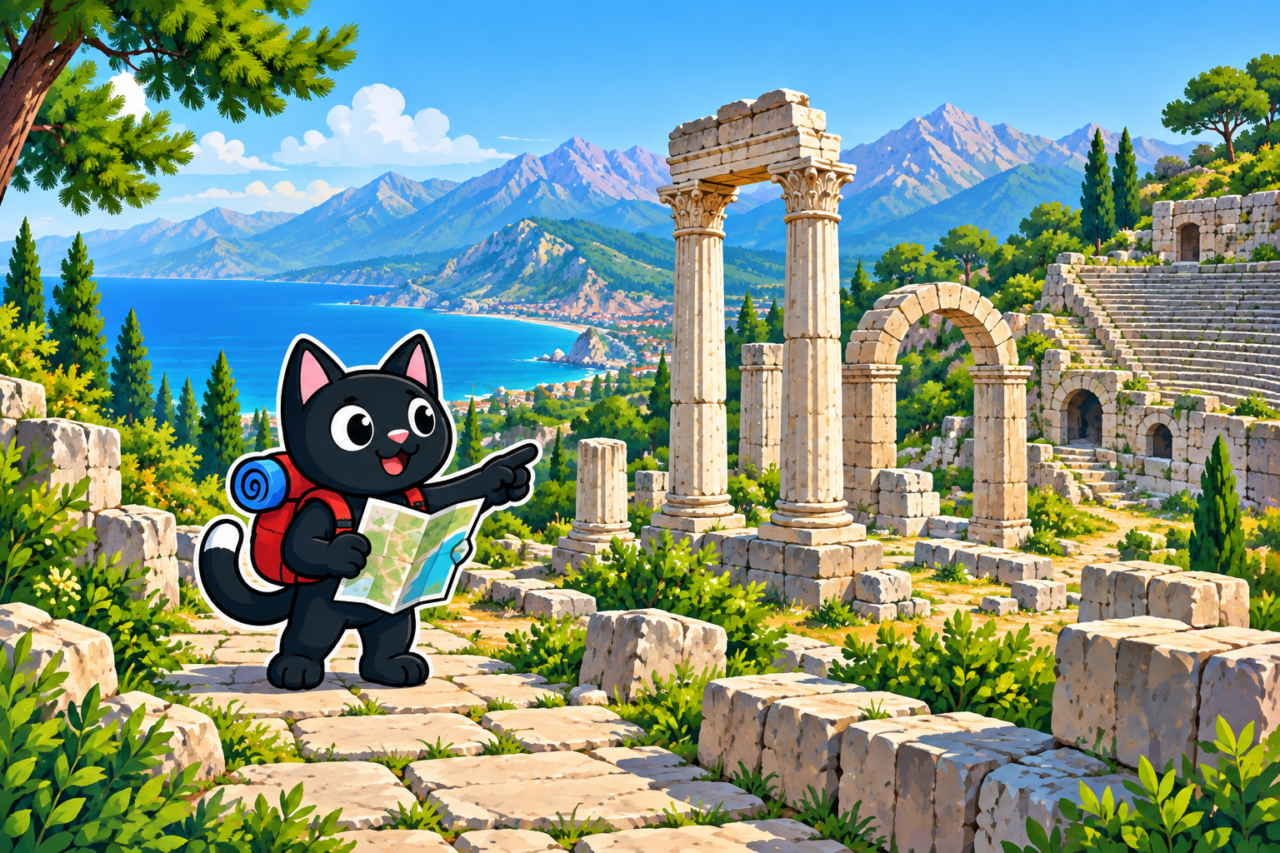
Termessos lies high in the mountains northwest of Antalya. You can simply come here to visit the ancient city. From the entrance, a trail climbs through the forest to walls, cisterns, and a theater at an elevation of approximately 1,000 meters. The view from its seats is one of the most beautiful among the ancient cities around Antalya. The short tour of the ruins is 6 km long with 150 m of elevation gain.

The long option is 22 km with almost 1,000 m of elevation gain and a descent into the valley. The trail may be overgrown with shrubs, so you need a large time buffer for the descent. At the bottom, you need to cross a canyon and reach a mountain road, where transport must be arranged in advance. The site is large and signs are not found everywhere, so know the direction of the theater beforehand. Bring your own water, and check the national park’s opening hours and the condition of the access road before your trip.
Neapolis
An ancient city in the mountains above Lake Doyran. Tombs, stonework, and the remains of buildings survive at the top, and the ruins offer views over the Antalya valley. We started at the lake and visited a ruined monastery along the way, but it is possible to drive closer to the beginning of the ascent. Our two tracks are 16 km with 330 m of elevation gain and 12.8 km with 720 m of gain.

Trebenna
The ruins of the ancient city are hidden in a pine forest in the mountains above Geyikbayırı. There are small caves nearby. One option is to walk approximately 16 km along an easy mountain road and finish the route at a café on the water.

Lyrboton
Lyrboton Kome is an ancient rural settlement on a plateau at Antalya’s northern edge. It was connected with Perge and is known as a major center of olive oil production. Houses, cisterns, tombs, and presses are visible among the well-preserved ruins; part of the city lies on an open area with views of Antalya, while another part continues into the forest. The short outing is 5 km with 110 m of elevation gain, and the loop through the forest with an approach to a cave is 9 km long.
Selge
An ancient city east of Antalya, in the mountains above Köprülü Canyon. The theater and remains of buildings stand among the houses of Altınkaya village, with rock pillars rising around them. The route is 10 km long with 230 m of elevation gain, and you can walk from Selge to Tazı Canyon.
Phaselis
A city on the shore with three harbors near Kemer. An easy route begins west of Çamyuva and follows the sea past beaches. The long option descends to the coast from the southern part of Kuzdere. You can finish in Tekirova or return the same way.
Olympos
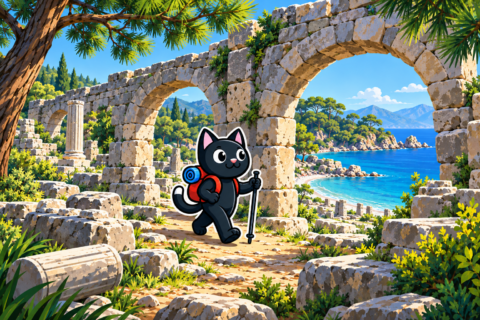
Ruins in a valley by the sea, near Çıralı. The ascent through the surrounding area is 15 km long with 770 m of elevation gain. It is convenient to combine Olympos with an overnight stay and an evening outing to the Chimaera flames.

Perge, Aspendos, and Sillyon
These cities stand on the plain east of Antalya. There are no mountain routes to them, but they are easy to visit by car in a single day.
Perge
Perge gives a clear impression of an ancient city’s layout: a wide colonnaded street, baths, gates, and a stadium. You can examine water-channel grooves, wheel marks in the stone, and fragments of mosaics. There is almost no shade, so in summer arrive at opening time or toward evening, and bring a hat and water.
Aspendos
Aspendos is known for its theater, with its well-preserved stage and acoustics. After the theater, leave time for the aqueduct and the less monumental part of the city, which few visitors reach.
Sillyon
Sillyon stands on a plateau and looks more rugged. Trails may be eroded, stones are loose, and there are no barriers. The ascent is suitable for confident walkers in dry weather. If access is closed, you can view the plateau from below.
The Saint Paul Trail begins at Perge and heads north through Köprülü.

How to Plan Your Day
- Choose one main site. A large complex such as Termessos or Perge easily takes half a day, and rushing to the next city cuts your visit short.
- Check the conditions. Opening hours, admission prices, roadworks, and visitor rules change.
- Protect the monuments. Do not climb on fragile walls, take stones, or leave the marked passages.
- Prepare for the sun. Exposed stone is hotter than the seashore, so calculate your water supply in advance. There are usually no stores on site.





Season
Late autumn, winter, and spring are more comfortable for long walks among the ruins. In summer, it is better to spend the middle of the day in the shade or on the road. Mountainous Termessos is cooler and windier than the plain near Perge, and if you visit both places in one day, you should take this into account when choosing clothing. With children, account for uneven steps, the absence of barriers, and long distances within the complexes.