Reliable communication and suitable insurance strengthen a hiking safety plan. This article covers available equipment, check-in deadlines, and important coverage terms.
Assess coverage
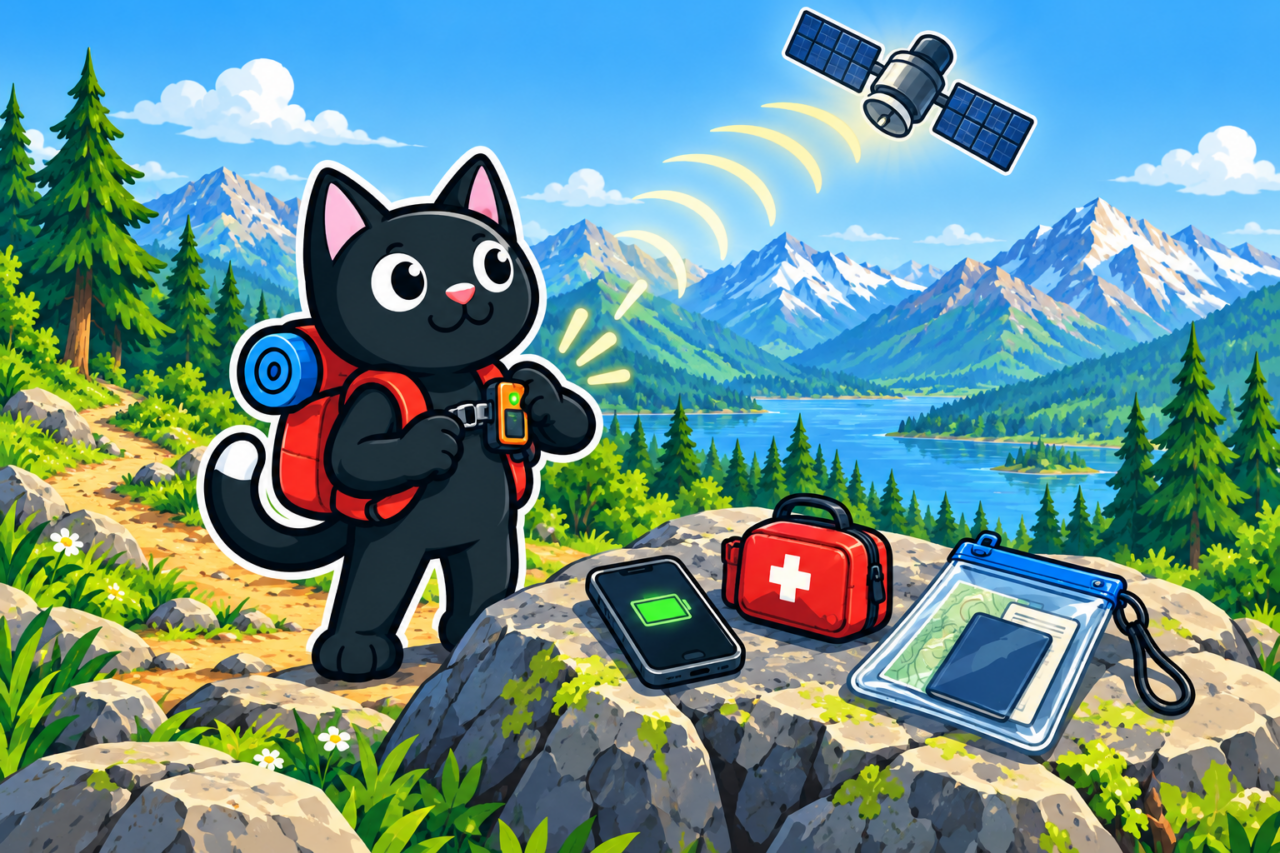
Carrier maps and recent reports help estimate coverage but remain only a guide. Forests, ravines, weather, and network traffic all affect reception, so a coverage report does not guarantee a signal at every point. Mark places with recent confirmation, such as settlements, passes, ranger stations, and mountain huts. A phone may have no internet in a gorge even though reception is known to work farther ahead. A downloaded offline map lets you find and report coordinates without a connection.

Charge phones before departure, install updates at home, and disable unnecessary background activity. This prevents unrelated tasks from consuming the power reserved for communication. Keep the phone in a warm, protected pocket and the power bank in a dry case. Batteries drain faster in the cold, so allow a larger margin in winter. The capacity that was sufficient in warm weather may not last for a trip of the same duration.

Set a communication schedule
Choose a contact at home who knows the plan and is ready to act after a delay. They need the group list, route, overnight stops, transport details, and time of the next message. This lets them understand your likely position even when they cannot ask you directly. “We’ll write in the evening” leaves too wide a waiting period, so set a specific deadline and an additional margin before they contact the authorities. A late check-in can then be judged against a shared agreement.

A short message should say that the group is together, give coordinates or a place name, and describe everyone’s condition. Mentioning the next section and expected check-in helps people at home know what to expect. Text often goes through on a weak signal when a call will not. One appointed hiker should handle communication; conflicting versions of the plan from different people make it difficult for relatives to know which route and deadline to follow.
Prepare a backup
- record regional emergency numbers and the land authority’s contacts;
- keep important phone numbers on paper;
- agree on a meeting point in case the group separates;
- consider a satellite communicator or emergency beacon for a remote route;
- practice sending coordinates before the trip, and learn emergency features in the manufacturer’s training or test mode.




A satellite device needs an active subscription, a clear view of the sky, and sufficient charge. Check its registration, plan, contact list, and controls before the trip. Everyone should understand its purpose and how to cancel an alert so they can use it when needed. An accidental press of the emergency button may also trigger a rescue response.
Choose insurance for the route
An ordinary travel policy may exclude independent hiking, mountaineering, search and rescue, or travel above a specified altitude. Read all terms and compare them with the route’s risks. Relevant details include the geographical area, altitude, activity, travel dates, chronic conditions, and evacuation method. A policy may provide no relevant coverage if your route exceeds its stated limit.

Ask whether the insurer pays for search, helicopter transport, medical care, and repatriation. These are different stages of assistance, so a general promise of coverage does not explain each one. Also ask whether you must call the assistance provider first and what documents reimbursement requires. After an incident, you need to know whom to contact and which evidence to collect. Keep the answers in writing so you can return to the exact terms.
Every participant needs the policy number, assistance phone number, and instructions for an incident. Store document copies offline. The leader should have a group insurance list that remains available even if an owner’s phone is dead. If a participant’s device switches off before help is requested, the leader can provide their insurance details and continue the conversation with the assistance service.
If help is needed
After an incident, first remove any immediate danger, assess the casualty, and determine the coordinates. Tell the operator what happened, how many people are present, the weather, visible landmarks, and the remaining battery level. Answer calmly and follow the instructions. After the call, conserve power and keep the line available so the conversation can continue and details can be clarified.

Insurance helps pay expenses and coordinate assistance, but the group itself still makes decisions about safe travel. The foundation is a realistic plan, first-aid kit, first-aid skills, and turning back in time. When continuing becomes unsafe, participants must decide when to return. A policy does not change trail conditions or make these decisions for them.
After an incident, keep receipts, medical reports, correspondence, and case numbers. Record call times and operator names so you can later reconstruct who said what and when. Even after a successful outcome, review how communication worked and what information was missing. Difficulty sending coordinates, for example, reveals what needs better preparation next time. The discussion connects the experience with the group’s future plan.