A weekend hike must be planned together with the journeys to and from the trail. Here is how to choose a format that fits the time available.
Calculate how much time you have
- Write down when you can actually leave home and the time by which you must return.
- Subtract travel, connections, waiting, and a margin for delays.
- The time remaining is the time available for hiking.

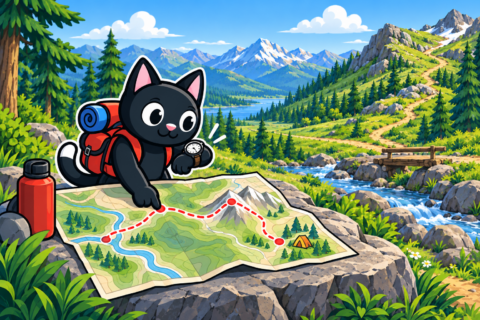
If the train reaches the trailhead at eleven, you cannot start walking at eight. Match the timetable to the actual trail start and add the approach from the stop. After a late arrival, check whether you can reach camp before dark. This immediately shows whether Saturday’s section must be shortened.
For a first trip, make Saturday the main walking day and keep Sunday short. After walking, you still need time for camp and dinner, and in the morning for unhurried packing. Two long days require a coordinated group and early start. A short Sunday leaves more time to strike camp and get home while the group is still learning its pace.
Someone else’s report does not give the right distance for your group; its author may have carried little, known the way, and barely stopped. Compare the route with your own walks under similar weight, terrain, and weather. Without such experience, shorten the mandatory part and add an optional loop only if time and energy remain. Record how long your usual breaks take.
Choose the route format
- A loop begins and ends in one place. It suits a car trip, but check parking permission and access after rain.
- A linear route starts and finishes in different places, so plan transport at both ends separately.
- An out-and-back route is simplest to organize because the group can turn around whenever it becomes tired.


Choose the main campsite and check current land rules before departure. An old tent symbol does not prove that camping is still permitted. Verify the water source because a seasonal stream may be dry by late summer. Use a confirmed backup campsite with water or carry enough yourself, including that water weight in the workload.

Provide an early exit
Mark a village, road with transport, or branch to a station where the route can end early. Find out beforehand how to leave from each point. A road line on a map promises neither a bus nor an available taxi. A verified exit lets a tired group finish without searching for transport on the spot. Check which side of the road has the needed stop.
Set the turnaround time at home. If the group has not reached the junction before a distant loop by that time, skip it. Base the deadline on the return timetable, distance back, and remaining daylight. At the junction, it will be easier to keep the agreement even when the objective seems close.
Before departure
Recheck the forecast, transport, and recent trail reports the day before. Heavy rain can make a familiar route slower. If only one evening service goes home, prepare another option: an early exit, different finish, or accommodation for an extra night. This is easier before the trip than after a delay on a wet trail.
Save maps and tickets offline. Give a trusted person the start, finish, and expected return time, and agree what they should do after missed contact. On a section without reception, this information remains useful both to you and to the person waiting at home. Test offline access before leaving.
Agree on pace and breaks within the group. If fast hikers disappear around a bend while others adjust packs, people begin waiting or chasing. Regroup at junctions. A shared rhythm leaves time to enjoy the walk and reduces the rush for return transport. Recalculate the section for the whole group if someone repeatedly falls behind.
Leave time after returning to dry gear, shower, and sleep. Unpack before a wet flysheet remains sealed in the backpack, and record shared expenses. This lets everyone complete the domestic end of the trip and recover before the new week. Check that all shared items have returned that evening.